
Both are legitimate choices for a mid-sized GCC business. The decision usually comes down to three things: total cost over five years, how much you value an integrated CRM and website, and whether a tier-one badge matters to your stakeholders.
We implement Odoo, so read this with that in mind. We have also lost deals to SAP Business One where it was the right answer, and this piece tries to be honest about when that is.
Cost over five years
The headline licence comparison understates the gap. SAP Business One carries a higher per-user licence, annual maintenance at a percentage of licence value, and an implementation cost that reflects a smaller pool of certified consultants in the region.
For a twenty-user GCC business, a five-year total cost of ownership comparison typically shows SAP Business One at two to four times Odoo, with implementation the largest single difference. That gap is real and it matters — but it is not the only consideration.
Where SAP Business One is genuinely stronger
Group standardisation
If your parent company runs SAP, aligning is usually the right call regardless of local cost. Consolidation, reporting and group audit all become easier.
Deep manufacturing
For complex discrete manufacturing with sophisticated planning requirements, SAP's MRP is more mature. Odoo's manufacturing is capable and improving quickly, but at the demanding end SAP still has depth.
Stakeholder perception
Not a technical argument, but a real one. Some boards, lenders and auditors respond differently to a tier-one name. If your funding environment cares, that is a legitimate input.
Where Odoo is genuinely stronger
Integrated breadth
CRM, website, e-commerce, marketing, HR, projects and field service in one system rather than assembled from third parties. For a business that wants sales pipeline and operations in the same place, this is a substantial practical advantage.
Speed of change
Adding a module or adjusting a workflow in Odoo is measured in days. In SAP Business One it is generally a project. For businesses whose requirements are still forming, that flexibility compounds.
No lock-in
Odoo is open source. Your data is in a standard PostgreSQL database, and you can change partner or self-host without renegotiating a licence. That is worth something, even if you never exercise it.
Regional compliance
Both handle UAE VAT and KSA e-invoicing. Odoo's localisations tend to arrive quickly and are widely deployed across the region — see our note on ZATCA Phase 2 for what compliance actually requires of either system.
A straightforward test
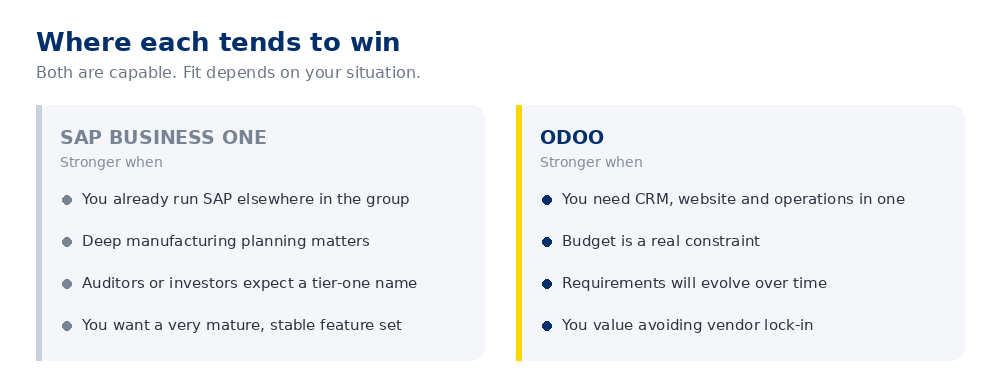
Lean SAP Business One if: your group already runs SAP, your manufacturing planning is genuinely complex, or your stakeholders specifically require a tier-one system.
Lean Odoo if: you want CRM and operations integrated, budget is a real constraint, your requirements will change, or you want to keep your options open.
The comparison people forget
Availability of local consultants. Whichever you choose, you will need support for years. In the UAE and Saudi Arabia the Odoo consultant pool is considerably larger and more competitively priced. If your chosen SAP partner becomes unavailable, replacing them is harder and more expensive.
That is not an argument against SAP. It is an argument for asking, during selection, what the support market looks like — not just what the implementation costs.
Weighing the two?
We will give you an honest view, including when SAP is the better answer for your situation.
Book a discovery call