Connect every channel. Then make the money agree.
Salla, ZID, Shopify, Noon, Amazon, Tabby, Tamara, Aramex and more — integrated with Odoo, with the settlement and COD reconciliation that most implementations leave undone.
Every channel keeps its own version of the truth
Your storefront thinks you have eleven units. The warehouse has nine. The marketplace sold two you did not know about. The payment gateway settled a lump sum three days ago that nobody has matched to orders, and the courier is holding cash from last month's deliveries.
None of this is unusual. It is what happens when systems are connected by people re-keying data, and it is why month-end takes three weeks.
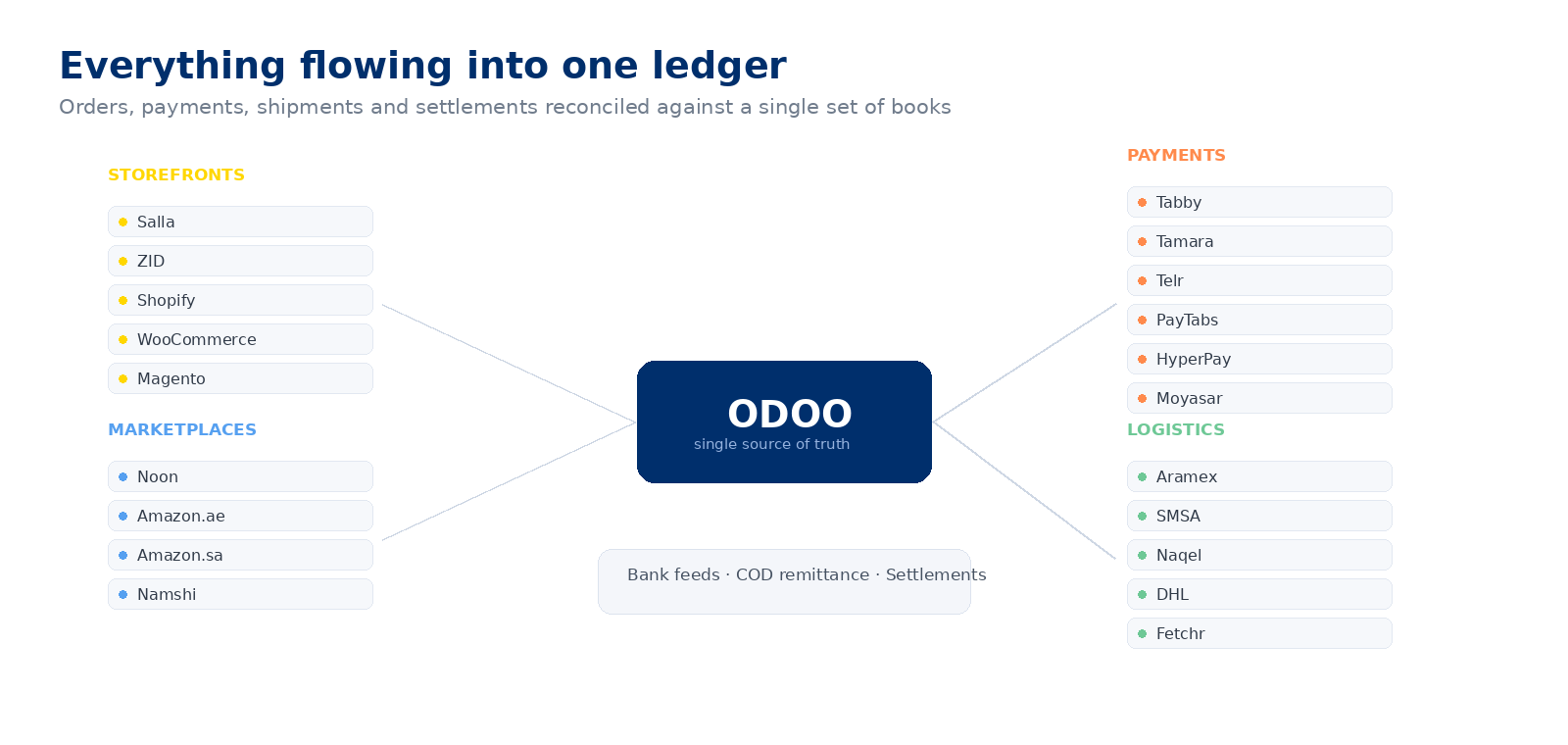
E-commerce platforms
Keep the storefront you have, or move it into Odoo. Either works — the integration is what determines whether your numbers agree.
Salla
The dominant platform for Saudi merchants. Orders, customers, products and stock synced both ways, with Arabic product data handled properly rather than mangled.
ZID
Widely used across Saudi Arabia and expanding regionally. Real-time order sync into Odoo, with fulfilment status flowing back to the customer.
Shopify
Two-way sync for products, variants, inventory and orders. Keep Shopify for the storefront and marketing; let Odoo own stock, fulfilment and accounting.
WooCommerce
Full WordPress integration including variable products, coupons and customer groups. Common where the site was built before the ERP.
Magento
Adobe Commerce and Magento Open Source. Suits complex catalogues and B2B pricing structures.
Odoo eCommerce
No integration at all, because the storefront runs directly on your ERP data. One catalogue, one stock figure, nothing to synchronise.
Selling where the customers already are
Marketplace orders arriving by email or CSV is how stock figures drift. Connected properly, they behave like any other sales channel.
Noon
Order ingestion, stock updates and fulfilment status. Commission and payout reconciliation handled as part of the build, not left to a spreadsheet.
Amazon.ae & Amazon.sa
FBA and merchant-fulfilled orders, inventory feeds, and settlement report reconciliation against your ledger.
Namshi & regional platforms
Fashion and lifestyle marketplaces, connected through whatever the platform offers — API where available, structured file exchange where not.
Gateways, and the settlements behind them
Configuring a checkout is the easy half. The half that matters is what happens when the money actually arrives.
Tabby & Tamara
Buy now pay later, dominant across the GCC. Order capture, settlement timing and the merchant fee posted where your accountant expects it.
Telr & PayTabs
Regional gateways with strong UAE and Saudi coverage. Multi-currency handled, settlements matched.
HyperPay & Moyasar
Widely used in Saudi Arabia, including Mada debit which behaves differently to card and needs configuring as such.
Network International
N-Genius and Network merchant services, common for established UAE retailers.
Stripe, Checkout.com, PayPal
International coverage where you sell beyond the region.
Apple Pay & Google Pay
Wallet payments, which increasingly convert better than card entry on mobile.
Aggregator channels
Restaurants and cloud kitchens across the Gulf typically sell through three or four aggregators at once, alongside their own storefront and dine-in. Each platform runs its own commission structure, its own promotional terms and its own payout cycle. We connect the order flow and, more importantly, tie each payout back to the orders that produced it.
Jahez
Saudi Arabia's largest aggregator. Order capture, menu and pricing control, and reconciliation of batched payouts against the underlying orders.
HungerStation
Nationwide Saudi coverage with category-dependent commission. Reconciled per order so contribution is visible by menu item, not just by platform.
Talabat
The dominant UAE platform, also active across Kuwait, Qatar, Bahrain and Oman. Multi-branch order routing with per-outlet reporting.
Deliveroo
UAE and Kuwait, generally skewed to premium venues. Order sync with promotional cost split tracked separately from platform-funded discounts.
Careem
Careem Now and Careem Quik across the UAE and wider region, including grocery and convenience formats alongside restaurant delivery.
Other platforms
Marsool, ToYou, Ninja, Noon Food and Smiles. Connected through whatever each platform offers — API where available, structured export where not.
The commission is not the whole cost. Aggregator commission is visible and expected. Merchant-funded promotional share, cancellation deductions and compensation charges are not, and they arrive netted into a single payout figure. Allocated properly, the ranking of your channels by profitability frequently reverses — the busiest platform is often the thinnest.
Shipping and last mile
Aramex
Regional coverage with label generation, tracking and COD remittance files handled.
SMSA & Naqel
Saudi domestic delivery, both heavily used for COD volume.
DHL & FedEx
International shipping with rate calculation at checkout.
Fetchr, Shipa & local couriers
UAE last mile, including same-day where the courier supports it.
Reconciliation — where most integrations stop short
Plenty of vendors will connect your storefront to your ERP. Far fewer will make the money agree afterwards. These are the four reconciliations that actually determine whether you can trust your accounts.
Cash on delivery remittance
The hardest one, and the most common in this region. The courier collects cash across hundreds of orders, holds it, deducts their fee, and remits a lump sum weeks later. We match every remittance line back to its originating order, post the courier fee separately, and flag uncollected or short-paid deliveries. Done properly this turns months of unreconciled COD into a daily review.
Payment gateway settlement
Gateways settle net of fees on their own cycle, batching many orders into one bank credit. We match the settlement to the underlying orders, post fees to their own account, and surface chargebacks, refunds and failed captures rather than letting them quietly erode margin.
Marketplace payout
Platforms deduct commission, fulfilment fees, promotional contributions and return costs before paying out. We reconcile the payout against the orders behind it so you can see actual net margin by channel — which is frequently not what the gross figures suggested.
Aggregator payout
Food delivery platforms settle weekly or bi-weekly as one net figure, with commission and merchant-funded promotional share already deducted, and with cancellations and refunds taken from the following cycle rather than the current one. That means a payout can never tie to its own period's sales. We reconcile across cycles, post each deduction to its own account, and hold the difference in a clearing account per platform so the open balance is visible daily.
Bank statement
The final check. Everything above should tie to what actually landed in the account. Where banks support automated feeds we use them; where they do not, structured imports keep it a review rather than re-keying.
Why this matters commercially. Businesses running unreconciled channels routinely discover their best-selling channel is their least profitable once commission, COD fees, returns and courier charges are properly allocated. You cannot fix what you cannot see.
Other systems we connect
Finance & banking
- Bank feeds where supported, structured imports where not
- Multi-currency with correct FX gain and loss treatment
- UAE VAT and KSA ZATCA e-invoicing endpoints
- Payroll and WPS file generation
Operations
- CRM and marketing platforms
- WhatsApp Business API for order updates
- Warehouse and barcode systems
- Legacy systems by API or scheduled file exchange
What a reliable integration looks like
Map the data first
Which fields, which direction, what happens on conflict. Most integration failures are data model disagreements discovered late.
Build with error handling
Retries, logging and an alert path to a human. Silent failure is the worst outcome because you keep trusting stale numbers.
Reconcile from day one
The integration is not finished when orders flow. It is finished when the money agrees.
Test with real volume
Sample data hides the problems. We test against your actual catalogue, order patterns and edge cases.
Monitor after go-live
APIs change, tokens expire, platforms deprecate endpoints. Ongoing monitoring is part of the support arrangement.
Integration questions
Which e-commerce platforms do you integrate with Odoo?
Salla and ZID for Saudi Arabia, Shopify, WooCommerce, Magento and BigCommerce internationally, plus Odoo's own eCommerce if you would rather not run a separate storefront. Marketplaces include Noon, Amazon.ae, Amazon.sa and Namshi.
How does cash on delivery reconciliation work?
This is the hardest problem in GCC e-commerce and the one most integrations ignore. The courier collects cash, holds it, deducts their fee, and remits days or weeks later in a lump sum covering hundreds of orders. We match each remittance line back to the originating order, post the courier fee separately, and flag anything uncollected or short-paid. Without that, COD revenue sits unreconciled for months.
Do you reconcile payment gateway settlements?
Yes, and it matters more than people expect. Gateways settle net of fees, on their own cycle, batching many orders into one bank credit. We match the settlement to the underlying orders, post the fee to its own account, and surface discrepancies — chargebacks, refunds and failed captures — rather than letting them quietly distort your margin.
How do you reconcile food delivery aggregator payouts?
Aggregators pay in batches, net of commission and net of your share of any promotional discount, and they deduct cancellations from the next cycle rather than the current one. The payout therefore never matches the period's orders. We give each platform its own clearing account and analytic account, post commission and promotional share per order rather than as a period-end lump, and reconcile the settlement across cycles. The residual balance is the amount genuinely in dispute, and it is visible daily instead of at month end.
What happens when an integration fails?
It gets logged, retried, and escalated to a person. An integration that fails silently is worse than no integration, because you carry on trusting numbers that stopped updating. Every connection we build has error handling and an alert path.
Can we sell on several channels with one stock figure?
That is the point of doing it properly. One catalogue, one stock number, allocated across channels according to rules you set. It prevents the classic failure where the same last unit sells simultaneously on Salla, Noon and the shop floor.
Do you connect bank accounts directly?
Where the bank supports it. Several UAE and Saudi banks offer feeds that pull transactions automatically. Where they do not, we set up structured statement imports so reconciliation is still a review rather than re-keying.
How long does an integration take?
A single storefront connection is usually two to three weeks. Payment gateway with settlement reconciliation, two to four. COD remittance matching, three to five, because the courier file formats vary and need mapping. Marketplaces depend on the platform's API maturity.
What if our platform is not on your list?
If it has an API, it can almost certainly be connected. We have built against documented APIs, undocumented ones, and in a few cases scheduled file exchanges where that was all the vendor offered.
Do you integrate food delivery platforms like Jahez and Talabat?
Yes. Jahez, HungerStation, Talabat, Deliveroo, Careem, Noon Food, ToYou, Chefz and Marsool. Orders flow into Odoo with item-level detail, menus and pricing sync outward, and outlet availability updates in real time. For multi-brand cloud kitchens we map outlets and brands so reporting works by both.
How do you handle aggregator commission?
Posted per order to its own account rather than netted off silently. Promotional discounts are split according to the campaign terms, cancellations and rider fees allocated separately. The result is that net margin by platform and by menu item is a report you run, not a reconstruction someone attempts at month end.
We run several cloud kitchen brands from one location. Can Odoo handle that?
Yes. Brands map to analytic dimensions and outlets to locations, so a single kitchen producing for four brands across three aggregators still reports cleanly by brand, by platform and by outlet. This is a common GCC pattern and it works well once configured deliberately.
How does Tabby and Tamara settlement differ from a card gateway?
The provider pays you upfront and collects instalments from the customer, so settlement timing and the merchant fee behave differently. Revenue should be recognised at order approval, the fee posted separately, and the settlement matched as its own event. Getting this wrong overstates margin and distorts cash flow forecasting.
Which channel is not reconciling?
Thirty minutes to look at where your numbers diverge and what it would take to make them agree.
Book a discovery call