
Most Odoo quotes in the UAE arrive without enough detail to compare. This is what actually drives the number, what a realistic range looks like in 2026, and the line items that get quietly left out until later.
Ask three Odoo partners in Dubai to quote the same project and you will get three numbers that differ by a factor of four. That is not because two of them are dishonest. It is because "implement Odoo" describes a range of work from a two-week configuration to a nine-month programme, and most proposals do not make clear which one they are describing.
This article sets out the cost structure honestly, including the parts that are uncomfortable to put in writing.
The three costs, kept separate
Every Odoo implementation has three distinct costs. Conflating them is the single most common reason budgets go wrong.
1. Licence
Odoo Community is free. Odoo Enterprise is charged per user per month, billed annually, with the price varying by region and negotiated discount. For a fifteen-user UAE business you should budget in the region of AED 12,000–20,000 per year for Enterprise.
The Community-versus-Enterprise decision deserves its own analysis, but the short version: Community covers accounting, sales, purchase, inventory, manufacturing, CRM and projects. Enterprise adds full accounting automation, studio customisation, quality management, field service, and mobile apps. Many SMEs run Community successfully for years.
2. Implementation
This is the consultancy work — requirements, configuration, data migration, testing, training, go-live. It is one-off, and it is where the variance lives.
3. Support
Ongoing. Bug fixes, user questions, small changes, version upgrades. Usually a monthly retainer.
What implementation actually costs in the UAE
The ranges below reflect fixed-price scopes for businesses of typical complexity. They assume a single company, a single currency, and standard Odoo modules.
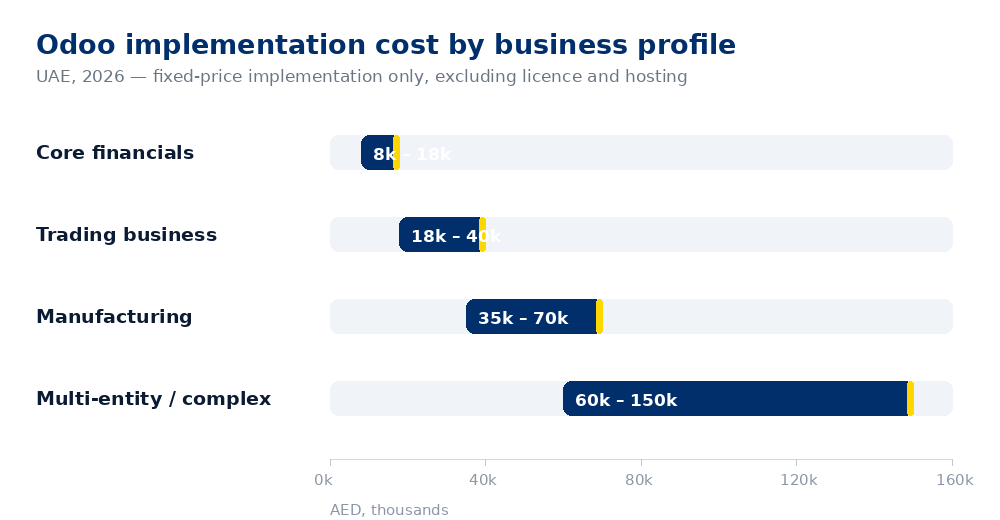
| Scope | Typical profile | Range (AED) |
|---|---|---|
| Core financials | Accounting, invoicing, VAT, basic reporting. 3–8 users. Replacing spreadsheets or Tally. | 8,000 – 18,000 |
| Trading business | Sales, purchase, inventory, accounting, VAT. Multi-warehouse. 8–20 users. | 18,000 – 40,000 |
| Manufacturing | Above plus MRP, BOMs, work orders, quality. 15–40 users. | 35,000 – 70,000 |
| Multi-entity / complex | Multiple companies, intercompany, multi-currency, integrations, custom development. | 60,000 – 150,000+ |
If a quote sits far below the relevant band, something has been excluded. Usually data migration, training, or testing. If it sits far above, either the scope contains genuine complexity that should be visible in the proposal, or you are paying for someone else's overhead.
For a sense of what these engagements look like in practice, our case studies set out the scope and outcome for manufacturing, trading and real estate clients across the UAE, Saudi Arabia and Pakistan.
The variables that move the number
Data migration
Consistently the most underestimated item. Moving a clean chart of accounts and a customer list is a day. Migrating five years of transactional history from a system with inconsistent product codes, duplicate customers and no reconciliation is weeks — and no amount of tooling fixes data that was never clean.
Ask any prospective partner what their assumption is on data quality, and what happens to the price if that assumption proves wrong. A proposal silent on this is a proposal with a variation order waiting in it.
Customisation
Every hour of custom code is an hour someone must maintain through every future version upgrade. Our position is straightforward: configure first, customise only where the standard system genuinely cannot meet a requirement that matters commercially. In practice that keeps most implementations at around 95% configuration.
Be wary of a partner who agrees to every customisation request without pushing back. They are optimising for the invoice, not for your total cost of ownership. Where custom work is genuinely warranted, we scope it separately through custom development so the cost is visible rather than buried.
Integrations
Payment gateways, e-commerce platforms, bank feeds, third-party logistics. Each is a defined piece of work. Each should be individually priced in the proposal rather than bundled into a single line.
Compliance configuration
UAE VAT is straightforward once configured correctly. Corporate Tax, and KSA e-invoicing under ZATCA if you trade into Saudi Arabia, are not. If compliance is in scope, it should appear as its own line — see our finance and VAT advisory for what that work involves.
Users and training
Twenty users across five departments need more training than twenty users doing the same job. Training is usually quoted as a fixed number of sessions — check whether that number is realistic for your headcount and shift patterns.
Costs that get left out
Hosting. Odoo.sh, a self-managed VPS, or on-premise. Budget AED 2,000–8,000 per year depending on size and whether you want managed backups.
Post-go-live support. The first sixty days generate the most questions. Confirm whether hypercare is included or billed.
Version upgrades. Odoo releases annually. Staying current is optional but deferring indefinitely accumulates cost.
Your own team's time. Not an invoice line, but real. Expect your finance lead and operations manager to spend meaningful hours in workshops, testing and validation. Projects fail more often from lack of internal time than from lack of budget.
How C2P prices
Fixed price against a defined scope. Scope is documented in a Business Requirements Document that you sign before configuration begins. Anything outside it is a change request, priced and agreed separately — not discovered on the final invoice.
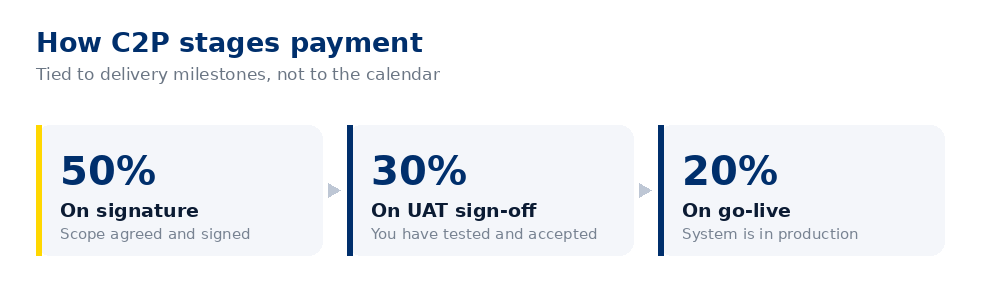
Support afterwards runs as a monthly retainer, from AED 1,200 for eight hours to AED 2,000 for sixteen.
We publish this because opaque pricing wastes everyone's time. If the range does not suit your budget, better to know in the first conversation than the fifth.
Questions worth asking any partner
- What exactly is in scope, and what is explicitly out?
- What assumptions about our data quality does this price rest on?
- Who is doing the work — the person in front of me, or someone I have not met?
- How many hours of training are included, and for how many people?
- What happens in the first month after go-live, and is it billed?
- How is a change request priced and approved?
- Can I speak to a client you implemented for in the last year?
A partner who answers these clearly is one worth shortlisting. A partner who deflects is telling you something useful. More on how we work is set out under C2P Consultants, the advisory division of the group.
Want a realistic number for your situation?
A 30-minute discovery call, no obligation. We will tell you honestly whether Odoo fits, and roughly what it would cost.
Book a discovery call