
Tally does accounting well. The reason businesses leave is rarely the accounting — it is everything Tally does not do. But the migration has a few traps that are much cheaper to avoid than to fix.
Across the UAE and Pakistan, Tally remains the default finance system for a large share of SMEs, and for good reason: it is inexpensive, familiar, and every accountant in the region knows it.
Businesses outgrow it for a consistent set of reasons — inventory across multiple locations, sales pipeline visibility, manufacturing, approval workflows, anything that requires the finance system to talk to operations. At that point the question becomes how to move without breaking the audit trail.
Decide what actually needs to move
This is the decision that determines the cost and the risk of the whole project, and it is usually made too casually.
Master data — yes
Chart of accounts, customers, suppliers, items, tax codes. These must come across, and they must be clean before they do.
Open balances — yes
Outstanding receivables and payables invoice by invoice, stock on hand, bank and cash balances, and the opening trial balance as at your cutover date.
Historical transactions — usually no
This is where people instinctively disagree, and where the cost sits. Migrating three years of transactional history means reconciling three years of data that was never designed to leave Tally. It is expensive, it introduces error, and in practice almost nobody queries it in the new system afterwards.
The pragmatic approach: migrate masters and opening balances into Odoo. Keep Tally in read-only mode for historical enquiry and audit. Your auditor is perfectly comfortable with this, and it removes the most expensive and error-prone part of the project.
Where migrations go wrong
Dirty master data
Almost every Tally database of any age contains the same problems: the same customer entered three times with slightly different spellings, item codes that changed convention halfway through, ledger accounts created ad hoc and never rationalised.
Migrating that mess into Odoo simply relocates it. Worse, Odoo enforces more structure than Tally does, so problems that were tolerable become blocking.
Clean before you migrate. It is unglamorous work and it is the single highest-return activity in the project.
Chart of accounts mapped one to one
Tally charts often grew organically. Odoo's structure is more disciplined, and a migration is a rare opportunity to rationalise. Mapping every legacy ledger straight across preserves years of accumulated untidiness that you will then live with for another decade.
Cutting over mid-period
Cut over at a period end — ideally financial year end, otherwise month end. Mid-month cutover means reconciling a partial period across two systems, which is unpleasant and avoidable.
No parallel run
Running both systems for one full close is the cheapest insurance available. If Odoo and Tally produce the same trial balance for the same month, you can switch off with confidence. Skipping this to save a few weeks is how businesses discover a mapping error in the middle of a VAT return.
A sequence that works
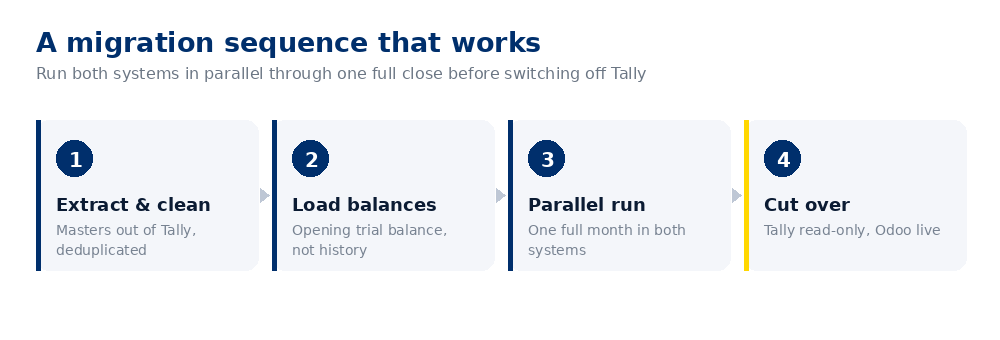
1. Extract and clean
Export masters from Tally. Deduplicate customers and suppliers, rationalise item codes, agree the target chart of accounts. Expect this to take longer than you think and to require your finance lead, not just the partner.
2. Load balances
Import cleaned masters into Odoo, then load opening balances as at the cutover date. Reconcile the opening trial balance against Tally line by line before proceeding. If it does not tie, stop and find out why.
3. Parallel run
Post one full month in both systems. Compare trial balance, VAT position, receivables ageing and stock valuation. Differences at this stage are cheap to fix; the same differences found three months later are not.
4. Cut over
Set Tally to read-only, retain it for the statutory retention period, and run Odoo live.
What you gain, realistically
Worth being clear-eyed. Moving to Odoo does not make your accounting better — Tally's accounting is sound. What changes is everything around it:
- Sales, inventory and finance in one system, so stock and margin reflect reality without reconciliation
- A real CRM pipeline instead of a spreadsheet
- Approval workflows on purchases and expenses
- Multi-user access with proper permissions rather than shared logins
- Reporting that finance can build without asking anyone
- UAE VAT and, where relevant, KSA e-invoicing compliance handled in the system rather than alongside it
If none of that is a live problem, Tally may still be the right answer. Migration for its own sake is not a good reason.
Time and cost
For a typical SME with clean-ish data and no unusual requirements, a Tally-to-Odoo move sits within a standard implementation — six to eight weeks including migration. Data cleaning is the variable; a database with serious duplication can add weeks on its own.
Cost-wise it falls into the core financials or trading bands set out in our UAE pricing breakdown, depending on how much beyond accounting you are switching on.
Thinking about moving off Tally?
A 30-minute call to look at your data, your requirements, and whether the move is worth making yet.
Book a discovery call