
Six to eight weeks is a realistic timeline for a standard Odoo implementation. Here is what happens in each phase, what your own team has to do, and the two places projects most often slip.
"Implementation" covers a lot of ground, and vague proposals are how budgets drift. This is the structure we work to, with honest notes about where the effort actually sits.
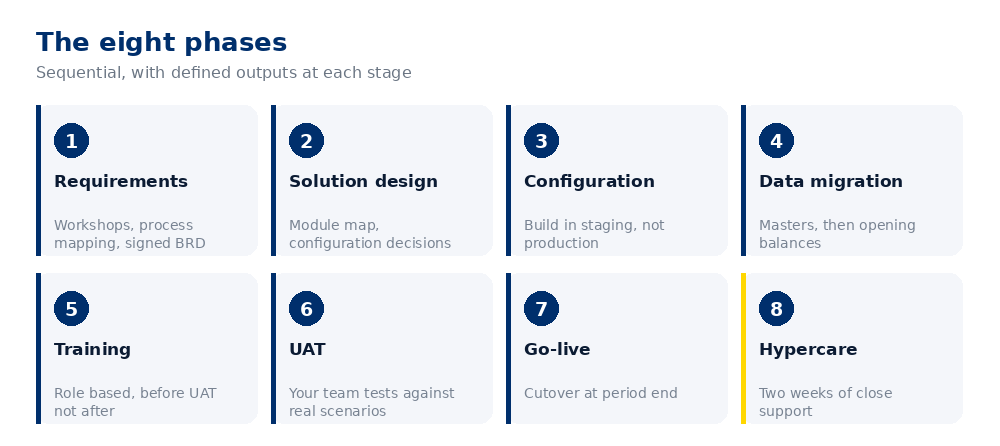
Phase 1 — Requirements (1 week)
Workshops with each department. What do you do now, what hurts, what must the new system do. The output is a Business Requirements Document that you read and sign.
This is the phase clients most often want to compress, and compressing it is the most reliable way to make the project expensive. Every requirement discovered in week six costs roughly ten times what it would have cost in week one.
Your time: significant. Department heads in workshops, finance lead reviewing the BRD properly rather than skimming it.
Phase 2 — Solution design (1 week)
Which Odoo modules, configured how, with which workflows. Where standard functionality does not fit, we decide explicitly whether to change the process or build something — and we push hard toward changing the process.
Output is a Solution Design Document mapping every requirement to how it will be met.
Phase 3 — Configuration (2 weeks)
The build. Chart of accounts, products, warehouses, workflows, approval rules, user permissions, reports. All in a staging environment — never directly in the system you will eventually rely on.
Your time: light. Occasional clarifications.
Phase 4 — Data migration (1 week)
Masters first — customers, suppliers, products, chart of accounts — then opening balances. Where the source data is messy, this is the phase that expands.
Your time: heavy, and often underestimated. Only your people can decide which of three near-identical customer records is the real one.
Phase 5 — Training (1 week)
Role-based, hands-on, in the configured system with your own data. Warehouse staff learn warehouse tasks; finance learns finance.
Training before UAT, not after. People cannot meaningfully test a system nobody has shown them.
Phase 6 — User acceptance testing (1 week)
Your team runs real scenarios — a full sales cycle, a purchase-to-payment, a month-end close — and confirms the system does what the BRD said it would.
UAT sign-off is a commercial milestone. It is also the last cheap moment to find a problem.
Your time: heavy. This is where projects fail quietly — a team too busy to test properly signs off on trust, then discovers the gap in production.
Phase 7 — Go-live (2–3 days)
Final data load, cutover, legacy system to read-only. Ideally at a period end. Ideally not the week before your year end or during peak season.
Phase 8 — Hypercare (2 weeks)
Close support while real transactions flow. Questions come thick in the first fortnight and thin rapidly after. Then the relationship moves to a support retainer.
Where it actually slips
Data quality. The gap between "our data is fine" and what the export reveals is the single most common cause of overrun. Find out early — ask for a data assessment in week one.
Your team's availability. Not budget. Time. A finance manager closing a quarter cannot also do UAT properly. Plan the project around your calendar, not against it.
Where the timeline extends legitimately
- Multiple companies or currencies — add one to two weeks
- Manufacturing with complex BOMs — add two weeks
- Third-party integrations — one to three weeks each
- Custom development — scoped and quoted separately
- More than roughly forty users — training extends
A proposal quoting four weeks for a manufacturing business with three warehouses is either excluding something or hoping you will not notice. Our pricing breakdown sets out how scope maps to cost.
Want a realistic timeline for your project?
A 30-minute call to understand your scope and give you an honest schedule.
Book a discovery call