
Both are solid Saudi platforms with real merchant bases. The decision usually comes down to how complex your operations are behind the storefront — not which has the nicer themes.
If you are selling in Saudi Arabia, Salla and ZID are the two names that come up first. Both are locally built, both handle Arabic properly, both integrate with Mada and the regional payment providers. Neither is a bad choice.
What separates them, in practice, is what happens once you have more than one warehouse, more than one price list, or a wholesale arm alongside retail.
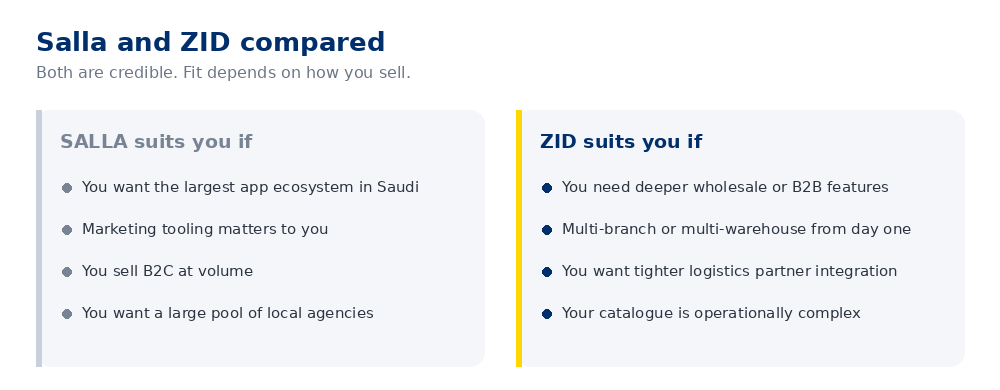
Where Salla tends to win
Ecosystem. The larger app marketplace and the larger pool of agencies who know it well. If you want a specific marketing integration or a themed storefront built quickly, you will usually find it on Salla first.
B2C at volume. The platform is built around high-volume consumer selling, and the tooling reflects that — abandoned cart flows, loyalty, promotional mechanics.
Familiarity. More merchants means more people who have solved your problem before.
Where ZID tends to win
Operational depth. Better handling of wholesale pricing, multi-branch inventory and B2B customer structures out of the box.
Logistics. Tighter native integration with regional couriers, which matters when a meaningful share of your orders are COD and the reconciliation depends on clean courier data.
Complex catalogues. Where products have many variants or configuration rules, ZID handles it with less compromise.
The question that actually decides it
Where does your complexity live? If it is in marketing and customer acquisition, Salla. If it is in inventory, fulfilment and pricing structure, ZID. Most merchants know which of those keeps them awake.
What neither of them solves
Whichever you choose, the storefront is not where your problems will be in eighteen months. They will be in the gap between the storefront and your accounts.
- Stock figures that disagree between the platform and the warehouse
- COD remittances from couriers that nobody has matched to orders
- Payment settlements landing as unexplained bank credits
- Marketplace orders arriving alongside storefront orders with no shared inventory
- No reliable view of margin by product once fees are properly allocated
This is the ERP layer, and it is the same problem whichever platform sits in front of it. We have written separately on reconciling cash on delivery, which is where most Saudi merchants lose visibility first.
A practical sequence
- Choose the platform on operating fit, not on theme design.
- Connect it to your ERP before volume grows, not after.
- Get stock synchronised in one direction with one source of truth.
- Build the COD and settlement reconciliation early, while volumes are small enough to check by hand.
- Only then invest heavily in acquisition.
Growing traffic on top of an unreconciled back end simply produces a larger mess faster.
Connecting Salla or ZID to your accounts?
Thirty minutes to look at your setup and what a clean integration would involve.
Book a discovery call