
Building an online shop is straightforward. Keeping stock accurate across the shop, the warehouse and the shop floor — while orders arrive from three channels and someone is picking in the aisle — is where businesses come unstuck.
That is an ERP problem wearing an e-commerce costume. This piece is about the integration work, which is where the budget and the risk actually sit.
The decision: Odoo storefront or keep Shopify?
A question we get in most first conversations. The honest answer depends on where your complexity sits.
Odoo eCommerce suits you if
- Inventory accuracy matters more to you than storefront design flexibility
- You sell B2B with customer-specific pricing and payment terms
- Your catalogue involves variants, kits or configurable products
- You would rather run one system than reconcile two
Keeping Shopify suits you if
- Your storefront already converts well and you do not want to disturb it
- You depend on the Shopify app ecosystem
- Marketing runs on Shopify tooling
- You would rather integrate than migrate
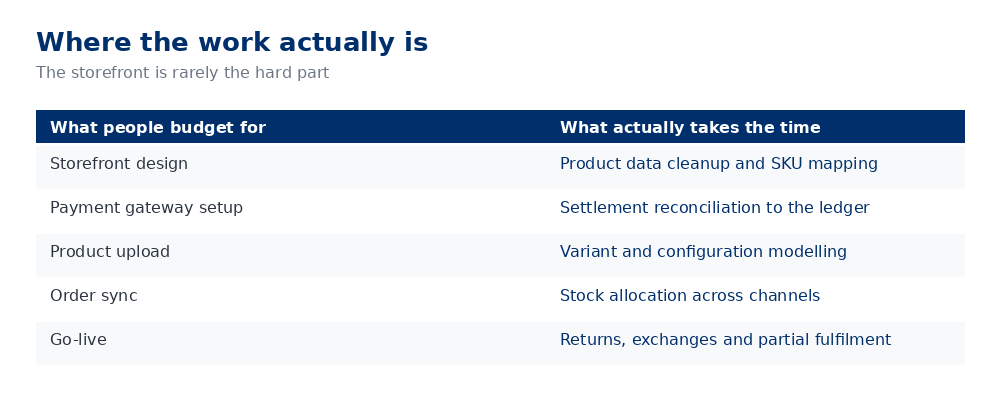
Either way, the integration is the project. Whichever storefront you keep, the work that determines success is making stock, pricing, orders and accounting agree with each other. Budget for that rather than for the shop.
What a proper integration handles
Stock, in both directions
The storefront shows what is genuinely available — accounting for what is reserved, what is in transit, and what is allocated to another channel. When the warehouse picks, the storefront knows.
Orders, with their edge cases
Not just the happy path. Partial fulfilment, backorders, cancellations, returns and exchanges all have to land correctly in both systems. This is where thin integrations fail.
Pricing and promotions
If a discount runs on the storefront, the order must arrive in the ERP at the discounted price, and the margin report must reflect it.
Settlement reconciliation
Payment gateways settle net of fees, in batches, on their own schedule. Matching those settlements to individual orders in the ledger is fiddly and routinely underestimated. If your integration stops at "the checkout works", your finance team inherits the problem.
Regional payment gateways
In the GCC that usually means Tabby and Tamara for buy-now-pay-later, Telr or PayTabs regionally, and Stripe or PayPal internationally. Each settles differently, and each needs its reconciliation configured rather than assumed.
Marketplaces
Noon, Amazon and regional platforms like ZID can feed orders into the same system. The value is that stock is allocated across every channel from one figure — the alternative is overselling on one channel while another sits on inventory.
What this looked like for a client
RIS CO trades furniture across Saudi Arabia through physical and online channels. Stock figures were unreliable and the online store operated separately from the warehouse. We connected Shopify to Odoo, added barcode and lot tracking, and automated purchase order generation.
They reported a 95% reduction in stock discrepancies and 70% faster order processing. The full account is in our case studies.
Selling online and not trusting your stock figures?
Thirty minutes to look at where the numbers diverge and what it would take to fix.
Book a discovery call